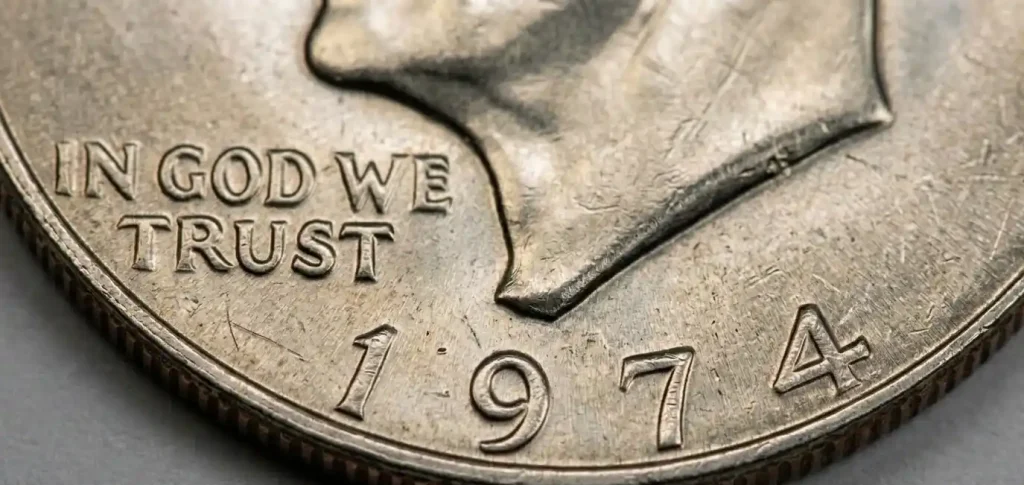
Standard issues intended for daily use utilized a copper and nickel base.
Special editions for collectors featured a specific silver portion to increase the intrinsic 1974 dollar coin value.
| Parameter | Regular Issue | Collector Issue |
| Total Mass | 22.68 g | 24.59 g |
| Metal Mix | 75% copper, 25% nickel | 40% silver, 60% copper |
| Pure Silver Weight | 0.00 g | 9.83 g |
| Diameter | 38.1 mm | 38.1 mm |
| Designer | Frank Gasparro | Frank Gasparro |
| Edge Type | Reeded | Reeded |
Mechanical properties of these blanks influence how well the design details survive the striking process.
Hardness in the copper-nickel mix often prevents achieving a deep, sharp strike on standard machinery.
Silver-based metal offers higher plasticity, resulting in clearer relief on the coin’s surface.
Production Statistics by Mint Facility
Mintage numbers directly determine the baseline rarity for each variety.
Official 1974 figures from the US Mint:
- Philadelphia (no mint mark) → 27,366,000 units
- Denver (D mark) → 45,517,000 units
- San Francisco (S mark, Copper-Nickel Proof) → 2,612,568 units
- San Francisco (S mark, Silver Uncirculated) → 1,900,156 units
- San Francisco (S mark, Silver Proof) → 1,306,579 units
Total production exceeding 78 million units keeps common versions highly accessible.
Significant scarcity exists only at the highest levels of the grading scale.
Philadelphia and Denver
Market pricing depends heavily on surface preservation and the absence of contact marks.
Most 1974 dollars exhibit bag marks sustained during bulk transport.
| Grade | Philadelphia (P) | Denver (D) |
| MS60 | $2.50 | $2.50 |
| MS63 | $5.50 | $5.50 |
| MS65 | $20.00 | $16.00 |
| MS66 | $95.00 | $65.00 |
| MS66+ | $380.00 | $230.00 |
| MS67 | $6,200.00 | $1,400.00 |
Extreme price jumps between MS66 and MS67 stem from the low population of certified examples.
Philadelphia strikes reach a critical rarity point at the MS67 level.
Population data as of early 2026:
Fewer than 18 specimens are registered in MS67 for the Philadelphia mint.
Price trend for Philadelphia MS66:
2015: $45 → 2026: $95
Average annual growth remains near 7.5%.
Silver San Francisco Issues: The 40% Premium
Coins containing silver were sold in special government packaging rather than placed in circulation.
Uncirculated versions arrived in blue envelopes, commonly called “Blue Ikes.”
Proof versions were encased in plastic holders within brown boxes, known as “Brown Ikes.”
Valuation factors for silver coins:
- Spot price of silver (the floor price)
- Numismatic premium (the condition-based price)
| Condition | 1974-S (Uncirculated) | 1974-S (Proof) |
| MS65 / PR65 | $18.00 | $22.00 |
| MS67 / PR67 | $28.00 | $30.00 |
| MS68 / PR68 | $60.00 | $45.00 |
| MS69 / PR69 | $350.00 | $125.00 |
| MS70 / PR70 | N/A | $4,800.00 |
Detecting imperfections during the strike reduces the chances of reaching the MS70 level.
Air exposure causes the silver surface to develop a thin layer of color.
Rainbow toning increases the final auction price by 20% to 50% depending on visual appeal.
Auction Records and Historical Sales
Historical transaction data confirms the investment trajectory of high-grade pieces.
Recent significant sales (last 10 years):
- 1974-D MS67+ (PCGS): Sold in 2021 for $3,600.
- 1974-P MS67 (PCGS): Sold in 2014 for $5,875.
- 1974-S Silver MS69 (PCGS): Sold in 2024 for $3,350.
Minor price drops of 4-6% in the MS65 segment reflect an increasing supply of certified coins.
MS67 segments remain stable because very few new examples enter the market.
Common obstacles to finding MS67 specimens:
- Worn dies used during high-speed production
- Rough handling at the mint facility
- Use the coin value checker app
- Environmental damage from improper long-term storage
Varieties and Mint Errors
Identifying deviations from standard designs allows collectors to find high-value anomalies.
Typical errors for the 1974 date:
- Double Die Obverse:
Focus on the “LIBERTY” lettering and the date numbers.
Confirmed MS63 specimens sell between $55 and $115.
- Missing Outer Layer:
Exposure of the red center on one or both sides.
Authentic examples bring $165 to $450.
- Off-Center Strikes:
Misalignment of the die and the blank coin.
10% shift → $110 value.
50% shift → $550+ value.
- Wrong Blank Errors:
Dollar designs struck on smaller coin blanks.
These extreme rarities fetch several thousand dollars at specialized auctions.
“Shadow Images” caused by die clashes interest only a small subset of specialists.
Factors Influencing Annual Value Changes
The 1974 dollar market follows specific economic cycles.
| Variable | Price Impact | Frequency |
| Silver Market Rise | +10% to +25% | Intermittent |
| Registry Set Competition | +5% to +15% | Seasonal |
| New Certified Discoveries | -3% to -8% | Monthly |
| General Inflation | +4% to +7% | Continuous |
Fluctuations in silver prices only impact the 1974-S issues.
Copper-nickel dollars from Philadelphia and Denver rely purely on collector demand.
Economic downturns often lead to stagnation in prices for lower grades (MS60-MS63).
Methodology for Grading and Condition Assessment
Evaluating a coin involves checking specific high-relief areas for wear.
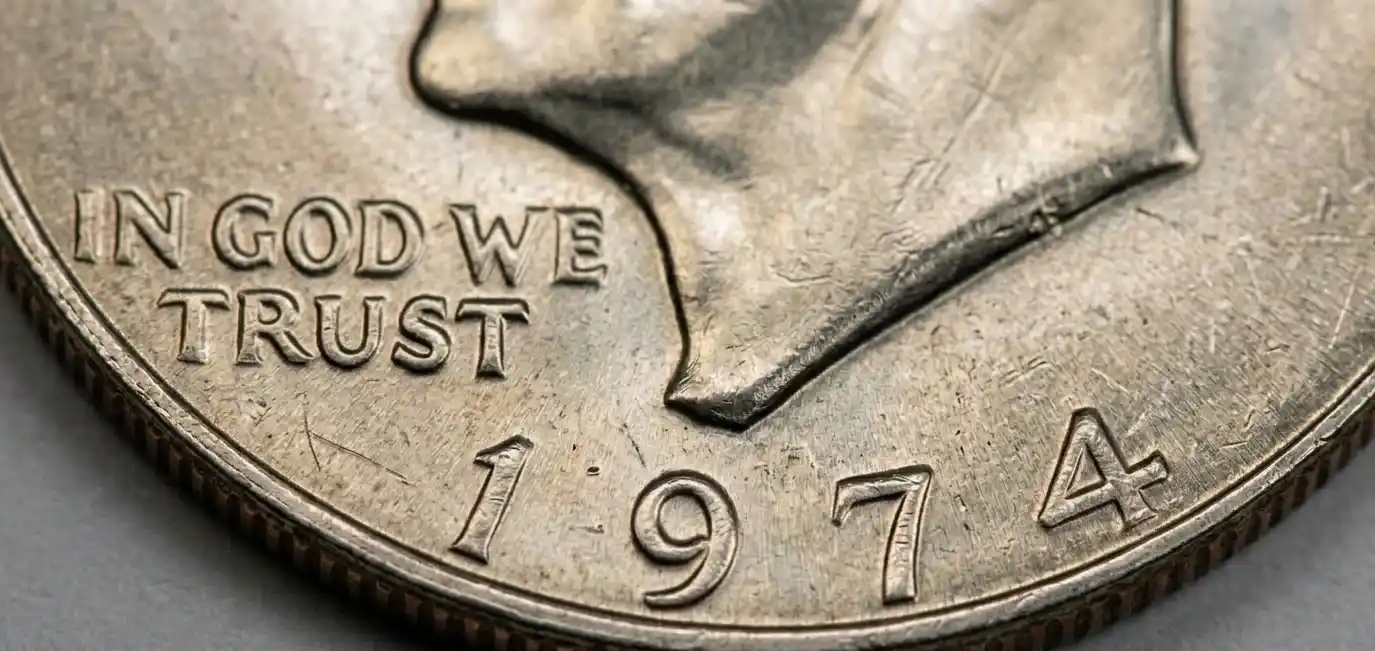
On the front, the cheek and temple of Dwight Eisenhower are critical.
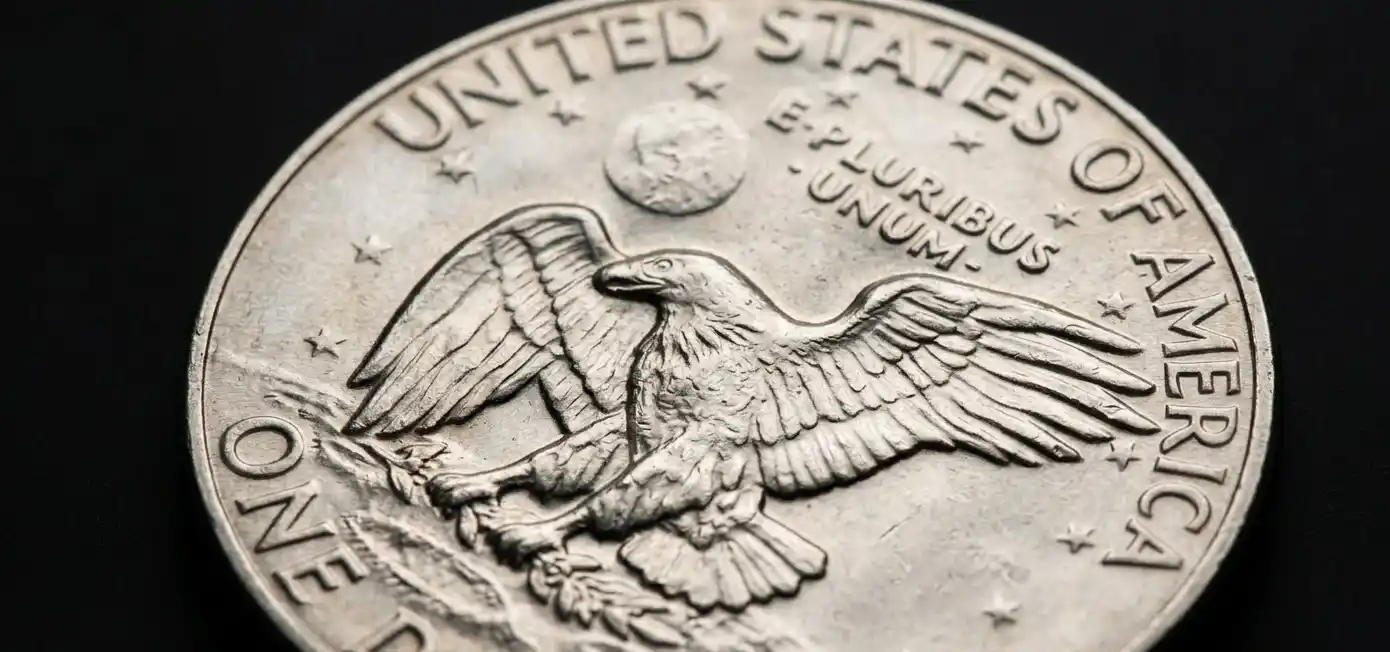
On the back, the surface of the moon and the crater edges must be sharp.
Storage Practices to Prevent Decay
Metal surfaces from 1974 require protection from humidity and sulfur.
Copper-nickel mixes turn dark when touching certain PVC plastics.
Recommended preservation methods:
- Hard plastic capsules made of polycarbonate
- Acid-free paper holders
- Humidity-controlled safes
Surface degradation leads to a permanent loss of grade and market value.
Professional slabbing locks the condition for decades, but anyway, you need to scan coins for value regularly.
Liquidity and Market Accessibility
Selling a 1974 dollar happens through dealer networks or online platforms.
Grades below MS64 offer high liquidity but very low profit margins.
Rare MS66+ grades require high-end auction houses for maximum returns.
Typical selling times:
- Common Grade (MS60-63) → 1-5 days.
- Middle Grade (MS64-65) → 10-25 days.
- Rare Grade (MS66+) → 4-10 months.
Auction fees range from 12% to 22% of the final hammer price.
Net profit is calculated by subtracting grading costs and fees from the final sale.
Market Outlook for 2026-2028
Current trends suggest steady prices for the silver 1974-S editions.
Philadelphia copper-nickel dollars in high grades remain the most difficult to source.
Price Forecast for 2027:
1974-P MS66 → potential 6% increase.
1974-S Proof PR69 → likely stable.
1974-D MS67 → potential 8% increase if demand for registry sets grows.
Growing numbers of collectors finishing the Eisenhower series support base prices.
This specific date remains a cornerstone for any complete set.
Unique minting conditions from 1974 ensure its lasting relevance in American coin history.